As much as I am not a fan of the notion that we, as teachers, are meant to play a sort of "babysitter" role for students, I think Kist makes quite a leap of faith by questioning the traditional structure of order in the school system.
I'm not sure if he was just making a hyperbole at the beginning of the chapter or if he was seriously inclined to allow students to more or less do whatever they wanted. To me, this all sounds like some dream-like utopia that in reality doesn't work as nicely as Kist might think.
Yes, under most circumstances, it is oddly condescending to make 17 year-olds ask to go to the bathroom. We have to keep in mind, however, that the students are there for a specific purpose--to learn. Teachers have the job to not only teach the content, but also maintain an environment conducive to learning. Because of this, we have to at least keep some order in the room. We have to at least have some of standardization.
Now that's not to say that I discourage student creativity and individualism. I just feel that there are so many other outlets for this that giving students the freedom of working on their own time, roaming the halls, etc. may be a step too far.
I honestly really hope that I misunderstood Kist's intentions. Even with a group of the most "ideal" students, I just can't see it all working out with the model that he dreams up.
Friday, November 23, 2012

Education doesn't only happen in a classroom
I don't know about you, but I would much rather make something for myself than pay extra to have someone else do it for me. Something about being able to say that I personally made something that functions just as well if not better than the store-bought version really makes me happy. Because of this, I've managed to make an electric guitar, leather armor, and a TV stand over the last few years. Now, I'm planning on putting together a PC for myself over winter break.
It seems like every time I end up making something, someone always asks, "How did you know what to do?" or they say something along the lines of "Oh, I'd never be able to figure that out." The problem is that they aren't willing to try. They aren't willing to do a little research and then just go do it. It's really that simple. A little bit of motivation can go a very long way.
[Now that I think about it, it might be the learning aspect of doing these projects that makes them so intriguing to me.]
These are some sites I've been used: Project Guitar, DIY (via Reddit), BuildaPC (also via Reddit), and of course, the old reliable Google search.
It's amazing how much information is out there and how much we are able to do if we just take the initiative to do so. Nothing is holding you back except yourself.
It seems like every time I end up making something, someone always asks, "How did you know what to do?" or they say something along the lines of "Oh, I'd never be able to figure that out." The problem is that they aren't willing to try. They aren't willing to do a little research and then just go do it. It's really that simple. A little bit of motivation can go a very long way.
[Now that I think about it, it might be the learning aspect of doing these projects that makes them so intriguing to me.]
These are some sites I've been used: Project Guitar, DIY (via Reddit), BuildaPC (also via Reddit), and of course, the old reliable Google search.
It's amazing how much information is out there and how much we are able to do if we just take the initiative to do so. Nothing is holding you back except yourself.
Friday, November 16, 2012
TIL
Have you ever been to Reddit.com? No, you say? Well, maybe that's a good thing; it can be very distracting and addicting--not so good for the somewhat unmotivated student (obviously none of us, right).
Anyhow, there's this subreddit called "TodayILearned." Here, people post all kinds of random things that they learned today--pretty much exactly what the title says. I've spent a long time browsing through the random things on the site, and I encourage you to do the same. Have fun, and try not to procrastinate too much!
Anyhow, there's this subreddit called "TodayILearned." Here, people post all kinds of random things that they learned today--pretty much exactly what the title says. I've spent a long time browsing through the random things on the site, and I encourage you to do the same. Have fun, and try not to procrastinate too much!
Role playing vs. drama
I like the idea of calling this week's work "role playing" rather than "drama."
By role playing, we begin to understand the thoughts of the character. We are given a better contextualization of the emotional side of the story that is often hard to pull out of plain text. Pirie uses the example of students understanding what it felt like to be Macbeth and go through the things he went through. Making this personal connection to the characters gives definite value to the students.
I'll be honest, I'm still a little skeptical about how to implement drama in the classroom without it being superficial and "only enacting what students already know." Even if the students are able to role play and see the emotions and thought process of the characters, how can we make sure that each student gets a chance at this? It's not like we can act out the same scene 10 or 15 times. The option I think of is a group discussion. I'm just not totally convince that there isn't a better way to meet the goals.
By role playing, we begin to understand the thoughts of the character. We are given a better contextualization of the emotional side of the story that is often hard to pull out of plain text. Pirie uses the example of students understanding what it felt like to be Macbeth and go through the things he went through. Making this personal connection to the characters gives definite value to the students.
I'll be honest, I'm still a little skeptical about how to implement drama in the classroom without it being superficial and "only enacting what students already know." Even if the students are able to role play and see the emotions and thought process of the characters, how can we make sure that each student gets a chance at this? It's not like we can act out the same scene 10 or 15 times. The option I think of is a group discussion. I'm just not totally convince that there isn't a better way to meet the goals.
Friday, November 9, 2012
Election 2012
Welp, another election has come and passed. Wasn't it fun? [you don't have to answer that.]
Some interesting things happened this year. First of all, several states legalized gay marriage. Also, Washington and Colorado legalized recreational use of marijuana. And finally, Puerto Rico voted to begin the process of becoming the 51st state. Crazy stuff, right?
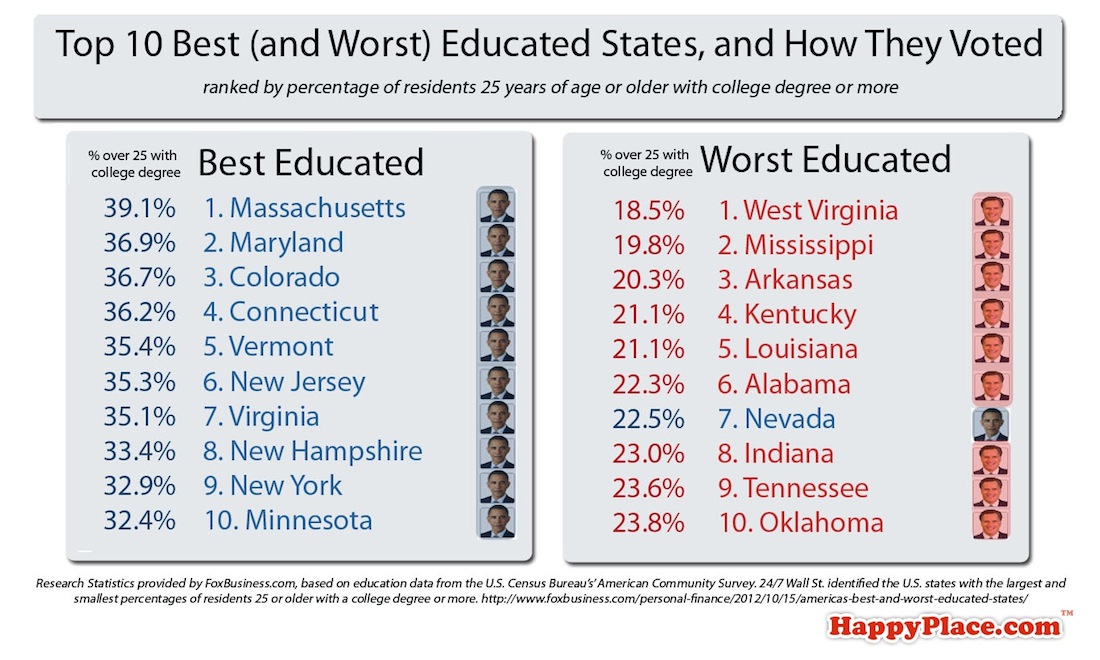
Well, something else that I found particularly interesting about this election was the demographics of the voters. Take a look at this graphic:
Some interesting things happened this year. First of all, several states legalized gay marriage. Also, Washington and Colorado legalized recreational use of marijuana. And finally, Puerto Rico voted to begin the process of becoming the 51st state. Crazy stuff, right?
Well, something else that I found particularly interesting about this election was the demographics of the voters. Take a look at this graphic:
I'm not trying to make any political statements here. I just found it very interesting that so many of the best-educated states voted Democrat. This may say something for the enriching experience that college provides and for the open, more liberal mindset that we often gain at college.
Graphic Responses
For this week's reading blog, I'll be taking a look at the article written by W.J. Broz.
Broz talks about the value of having students do a graphic response supported by a rationale rather than simply writing a tradition paper.
He writes, "The effort this deer-hunter student put into his graphic response is one of the phenomena I have continued to observe: students at all levels of ability will put great effort into graphic interpretations." It really is suprising how much more willing a student is to put effort into a visual response rather than a written response. I have no clue what it is about graphic responses that make students do this, but either way it's true. I remember spending absurd amounts of time in high school on what could have easily been quick projects. Instead, for some strange reason, I felt that it was necessary to put a ton of effort into things. I really don't know why . . . any ideas why we do this?
There's another component to the value of graphic responses. Broz writes, "With graphic responses, however, I have found that students cannot easily be 'too general.'" I never really had a big problem with being too general, but I know many, many people who do have this problem. Like Broz says, doing a graphic response can help alleviate the problem. It's hard to make a quality paper by being general, but it's even harder to make a quality graphic response by being general.
Friday, November 2, 2012
Some comments on Kist, Chapter 5
This week I just have a few things to comment on about the reading from the Kist book.
On page 98, Kist talks about how one of the teachers involved in the Facebook group logged on solely to act as a "devil's advocate." Personally, I think this is a great way to teach students how to not only form their own opinion, but to be able to defend it. It's one thing to make a statement, but to defend it against sound, opposing logic is an entirely different thing.
On page 99, Kist talks about how the students were more motivated to keep up with the Facebook group "because they own this, they love it." I guess I can say that I feel a bit of that for this blog. Though I'm not a huge fan of blogging (mostly because of a lack of time), I still feel that this is, in a way, a representation of me, and I want it to be an adequate one.
Telecommuting also came up in the chapter. I have a lot of mixed feelings about this. In college, I would love to have this sort of set up. It would save me a 15 minute drive and a gallon or two of gas while allowing me to more or less create my own schedule. I'd love for that to happen at the college level.
However, I don't know if I would trust it to work at the high school level. I just have trouble thinking that high schoolers would have the dedication to keep on task. I know that personally, if I were given the option to telecommute in high school, I would have jumped on it solely because I wanted to sleep in more. Being a pretty lazy student in high school, I doubt that I would have kept on track. Now that I'm at the college level and I care much more about school, I don't think it would be a problem. Kist reports that the program has been a success though, so I'm just not entirely sure what to think at this point.
On page 98, Kist talks about how one of the teachers involved in the Facebook group logged on solely to act as a "devil's advocate." Personally, I think this is a great way to teach students how to not only form their own opinion, but to be able to defend it. It's one thing to make a statement, but to defend it against sound, opposing logic is an entirely different thing.
On page 99, Kist talks about how the students were more motivated to keep up with the Facebook group "because they own this, they love it." I guess I can say that I feel a bit of that for this blog. Though I'm not a huge fan of blogging (mostly because of a lack of time), I still feel that this is, in a way, a representation of me, and I want it to be an adequate one.
Telecommuting also came up in the chapter. I have a lot of mixed feelings about this. In college, I would love to have this sort of set up. It would save me a 15 minute drive and a gallon or two of gas while allowing me to more or less create my own schedule. I'd love for that to happen at the college level.
However, I don't know if I would trust it to work at the high school level. I just have trouble thinking that high schoolers would have the dedication to keep on task. I know that personally, if I were given the option to telecommute in high school, I would have jumped on it solely because I wanted to sleep in more. Being a pretty lazy student in high school, I doubt that I would have kept on track. Now that I'm at the college level and I care much more about school, I don't think it would be a problem. Kist reports that the program has been a success though, so I'm just not entirely sure what to think at this point.
Transcendentalists and why we should all be reading Emerson RIGHT NOW
As some of you may know, Permenter's American Lit I course is currently studying transcendentalism. "What's transcendentalism?" you might ask. Well, that's a very difficult question that I should be writing a 1000 word essay about (you'd think by this point, I'd have gotten better with procrastination).
Anyhow, the movement was fathered by Ralph Waldo Emerson. He and his contemporaries--Thoreau, Fuller, Alcott, etc.--believed in experiencing the world for oneself and giving meaning to things through one's own perspective. They heavily supported individualism, but at the same time realized that we are all connected to each other, that each of our actions has an effect on others.
That's much less than even a sparknotes version of it all. I HIGHLY recommend reading Emerson's works, especially "Self-Reliance." Also, check up on some Thoreau while you're at it. (For an extremely epic experience, read "Self-Reliance" aloud while playing some Explosions in the Sky.)
Quotes for you to enjoy:
"Don't be too timid and squeamish about your actions. All life is an experiment. The more experiments you make the better.”
Anyhow, the movement was fathered by Ralph Waldo Emerson. He and his contemporaries--Thoreau, Fuller, Alcott, etc.--believed in experiencing the world for oneself and giving meaning to things through one's own perspective. They heavily supported individualism, but at the same time realized that we are all connected to each other, that each of our actions has an effect on others.
That's much less than even a sparknotes version of it all. I HIGHLY recommend reading Emerson's works, especially "Self-Reliance." Also, check up on some Thoreau while you're at it. (For an extremely epic experience, read "Self-Reliance" aloud while playing some Explosions in the Sky.)
Quotes for you to enjoy:
"Don't be too timid and squeamish about your actions. All life is an experiment. The more experiments you make the better.”
"Is it so bad, then, to be misunderstood? Pythagoras was misunderstood, and Socrates, and Jesus, and Luther, and Copernicus, and Galileo, and Newton, and every pure and wise spirit that ever took flesh. To be great is to be misunderstood.”
"The only person you are destined to become is the person you decide to be.”
"Guard well your spare moments. They are like uncut diamonds. Discard them and their value will never be known. Improve them and they will become the brightest gems in a useful life.”
"The only person you are destined to become is the person you decide to be.”
"Guard well your spare moments. They are like uncut diamonds. Discard them and their value will never be known. Improve them and they will become the brightest gems in a useful life.”
Friday, October 19, 2012
The importance of getting an education
Tonight, I realized the importance of getting an education, of bettering myself, and of moving forward in life rather than stagnantly and lazily keeping the status quo, the easy way out. Tonight was one of those nights; we've all had them. Tonight... well, let's not talk about tonight.
I'm sure many of you know that working fast food or retail jobs can be an absolute nightmare at times. But, we do it because we need to pay the bills and the work is easy to find and get. We work these jobs not necessarily to take advantage of the easy way out but because we have to. We have to temporarily sacrifice our livelihood so that we can someday work the job of our dreams.
Others take the easy way out. They don't have the drive to continue in school, nor the desire to work their way out of the minimum wage rut even if they can't get through school.
We, as future teachers, hold a huge responsibility. We have to teach kids more than just the materials; we have to teach them about life. We have to encourage them to be everything that they can be, to meet their potential. We have to let them know that they don't have to be rocket scientists or nuclear engineers, just that they can't settle for the easy way out. We have to encourage them to make the best of what they have and to always be pushing for more.
No one wants to work in a fast food joint all their life. Let's help the next generation so they won't have to put up with nights like this for any longer than they have to.
I'm sure many of you know that working fast food or retail jobs can be an absolute nightmare at times. But, we do it because we need to pay the bills and the work is easy to find and get. We work these jobs not necessarily to take advantage of the easy way out but because we have to. We have to temporarily sacrifice our livelihood so that we can someday work the job of our dreams.
Others take the easy way out. They don't have the drive to continue in school, nor the desire to work their way out of the minimum wage rut even if they can't get through school.
We, as future teachers, hold a huge responsibility. We have to teach kids more than just the materials; we have to teach them about life. We have to encourage them to be everything that they can be, to meet their potential. We have to let them know that they don't have to be rocket scientists or nuclear engineers, just that they can't settle for the easy way out. We have to encourage them to make the best of what they have and to always be pushing for more.
No one wants to work in a fast food joint all their life. Let's help the next generation so they won't have to put up with nights like this for any longer than they have to.
Video production in the classroom
Coming a high school experience in which the teachers gave us A LOT of freedom in our projects, I've been exposed to both the advantages and disadvantages of using a video production as a means of evaluation.
Lund was absolutely correct in saying that the the pre-production aspect of the project was the most important. In high school, we were given almost too much freedom with our projects. The focus was really only placed on the final project, not so much in how we got there. As a teacher, I'd like to follow Lund's opinion and focus a bit more on the planning aspect of the project. I would set up a few days for the students to work on making at least a general script and plan out exactly how they would go about conveying their message. The actual production element, I wouldn't stress over as much. It seems as though we often get caught in the little, meaningless bits when we focus too much on production, and I'd rather steer the class in a different direction.
(By the way, this is one reason why I'm looking forward to the 20 shot film project that we'll be doing later this semester.)
I also liked that Lund said "visual and aural must be complimentary." Again, the planning portion of the assignment can assure that there is a connection between the two. If you just hand a group a camera and tell them to make a movie, you'll probably end up with something that has moments of good aural content and moments of good visual content. Though they may happen to mix without much planing, they would certainly match up better if there were more focus on the pre-production and less on how polished the final product came out.
Lund was absolutely correct in saying that the the pre-production aspect of the project was the most important. In high school, we were given almost too much freedom with our projects. The focus was really only placed on the final project, not so much in how we got there. As a teacher, I'd like to follow Lund's opinion and focus a bit more on the planning aspect of the project. I would set up a few days for the students to work on making at least a general script and plan out exactly how they would go about conveying their message. The actual production element, I wouldn't stress over as much. It seems as though we often get caught in the little, meaningless bits when we focus too much on production, and I'd rather steer the class in a different direction.
(By the way, this is one reason why I'm looking forward to the 20 shot film project that we'll be doing later this semester.)
I also liked that Lund said "visual and aural must be complimentary." Again, the planning portion of the assignment can assure that there is a connection between the two. If you just hand a group a camera and tell them to make a movie, you'll probably end up with something that has moments of good aural content and moments of good visual content. Though they may happen to mix without much planing, they would certainly match up better if there were more focus on the pre-production and less on how polished the final product came out.
Friday, October 5, 2012
Not feeling too "Grande" today.
This is most likely going to be a short post. It's been a LONG week capstoned by an even longer day today. 7 minutes after I normally leave my house, I decided to finally wake up. Then worked what turned out to be about a 10 hour shift serving greasy pizzas to the hungry masses hoarding the store. Anyhow, no time for thinking and even less time for blogging.
Pages 82 and 83 of the Kist reading bring up an issue that I've always had with blogging and podcasting--what is the likelihood of someone actually viewing it? I mean, obviously we're all going to view each other's blogs and such. But if we removed ourselves from the class, we most likely wouldn't be getting much response from the random passerby. At that point, I would almost feel like I were just posting a personal journal. Granted, there's a time and place for that, but what if you're truly seeking to have an audience?
I honestly don't know how to get more traffic to a blog (or to any website for that matter). Short of advertising through twitter, facebook, etc. I can imagine that it would take quite a while for a blog to really take off.
Kist gives us the blog search engine Technorati, but I have my doubts about how closely it combs through the millions of blogs that existence in the depths of the web.
I don't know. I guess I'm just being a bit cynical about the amount of traffic the average blogger is going to generate. It'd be nice if some could convince me otherwise.
(And in the meantime, enjoy the break!)
Monday, October 1, 2012
Exploring the blogging world
Welp, we spent some time playing around on the internet. Usually, that's a terrible idea; the internet is a scary place, ya know. (If you don't think the internet is all that scary, that's good; you haven't gone too far in yet. Once you get to the core depths of the internet, you'll never be able to return.)
Anyhow.
I was surprised when I went to one of the first blogs that Wilber suggested, Plethora Tech. It almost seemed as if the blog has taken a shift away from teaching and is now focused more on some sort of insurance policy jargon. Honestly, I didn't get much of anything from it and I was a bit disappointed.
Moving on then...
Next I checked out a science teacher's blog that is, in fact, about teaching. This one, I definitely recommend. It is mostly personal reflection, almost a bit of a journal. I found his writing to be inspiring and extremely thoughtful. At the same time, I also learned some things from him. His post about evolution and religion was especially insightful. He presents it in a very neutral way that few often take.
Finally, I ended the internet expoloration by checking out Mrs. Polselli's Grade 3 Wiki. It seems like a fairly basic wiki. She posts resources for both students and parents. I didn't find anything particularly insightful here, but that isn't necessarily the nature of a wiki. She uses it as a substitute for programs like D2L and BlackBoard. A good example to follow if needed.
Anyone else check these ones out?
Anyhow.
I was surprised when I went to one of the first blogs that Wilber suggested, Plethora Tech. It almost seemed as if the blog has taken a shift away from teaching and is now focused more on some sort of insurance policy jargon. Honestly, I didn't get much of anything from it and I was a bit disappointed.
Moving on then...
Next I checked out a science teacher's blog that is, in fact, about teaching. This one, I definitely recommend. It is mostly personal reflection, almost a bit of a journal. I found his writing to be inspiring and extremely thoughtful. At the same time, I also learned some things from him. His post about evolution and religion was especially insightful. He presents it in a very neutral way that few often take.
Finally, I ended the internet expoloration by checking out Mrs. Polselli's Grade 3 Wiki. It seems like a fairly basic wiki. She posts resources for both students and parents. I didn't find anything particularly insightful here, but that isn't necessarily the nature of a wiki. She uses it as a substitute for programs like D2L and BlackBoard. A good example to follow if needed.
Anyone else check these ones out?
Friday, September 28, 2012
this blog post Is So Meta Even This Acronym
Well, it's time to blog about blogging. Wilber, chapter 3 will be the focus of tonight's blog.
I'll be honest, before this class, I was never a big fan of blogging. Or, maybe I just didn't see the full value of it.
The first point that Wilber brings up is the use of blogs as a way to collaborate with fellow teachers and professionals in the same field as you. I had really thought of this until I read it. I immediately realized that I already do a form of this already by browsing niche interest forums and discussing specific topics with forum members. It's not exactly blogging, but it is the same concept.
Next, on page 49, Wilber talks about how blogs give students a chance to write for a semi-public audience. I mean, they likely won't get a lot of traffic to their blog, but they still have to be mindful of the fact that they really are writing for a public audience. It makes their work have more meaning, more than just to make the teacher happy.
This leads to another major point that Wilber makes. When a student finds more meaning in their work, they're more likely to keep to doing it. On page 51, Wilber talks about how blogging encourages regular writing practice. The more you write, the better you get (or at least, the more comfortable you get). That's one of our main jobs as teachers--get kids comfortable with writing and communicating. No matter what job they end up in, they will have to use the vital skills of communication. The more prepared they are for that reality, the better. Blogging could be a useful way to get them comfortable with communicating.
[citation needed]
So, I have a friend who is currently a sophomore here at SRU. We were eating lunch together earlier this week and he began complaining about a research assignment he was given in one of his computer classes. While some of his complaints were arguably brought on by his stubbornness, our conversation sparked some thoughts in my mind.
The complaint that most frustrated me was that his professor required the students to use sources from numerous types of media (book, website, journal, etc.). At first, this actually seems pretty logical; you want to have a variety of sources to base your argument on. But what I found frustrating is that nowadays there is so much overlap between print and non-print media that it almost seems foolish to require specific ones. It would be better to simply require "credible" sources, wouldn't it?
That brings up the issue of defining "credible." My friend has never been taught how to look up journal articles on the library website. Should we consider only journal articles as "credible," or are regular websites worthwhile as well? Where do we draw the line between expert and random blogger or mere aggregate site?
Personally, I don't really have an answer. Each case is different; each topic of research is different.
I think this is something that we have to keep in mind as we enter the real world. We have to know who will be judging the sources of our materials (a boss, publishing company, etc), and we have to define our own guidelines of what is "credible." Students hate ambiguities, and the have every right to do so.
Friday, September 21, 2012
Breaking out of boxes, or why the five paragraph essay is undermining quality writing
In Swenson et. al. we encounter several instances of criticism towards the traditional structure of essay writing--the "beloved" 5 paragraph essay.
"In an era of growing concern about student writing scores on standardized tests, we are also seeing large numbers of teachers and schools revert from more progressive pedagogies to reductionistic approaches that suggest that students need to master only a few steps to become successful writers."
I remember in high school being told by some of the not-so-engaging teachers that we should make our essays in a specific format and that if for some reason we decided to write in a more "progressive" way, they would actually deduct points. This mostly stemmed from there lack of effort in grading and their desire to standardize their work (at least, that's my theory).
". . . formulaic conceptions of writing, instruction, and texts encourage students not to think critically . . . even as they reinforce the positivist impression that Truth can be known and communicated if writers only train . . . in a clear, linear, and orderly fashion."
Again, I remember instance where I felt limited by the supposedly "correct" structure of how writing "should" be. Even at the college level I struggled with this. In Intro. to Ed. we were forced under strict guidelines of APA formatting. My writing was unimaginative and robotic at times. Even in College Writing II, I felt that my creativity and skills were being held back by the need to fit what "proper" writing is supposed to look like.
I propose that we, as future teachers, teach the traditional ways but also encourage other means of expression. We need to keep the past traditions in mind while incorporating new possibilities for the kids to try. As long as they effectively convey their point, I think they should be encouraged to do so in a variety of ways.
"In an era of growing concern about student writing scores on standardized tests, we are also seeing large numbers of teachers and schools revert from more progressive pedagogies to reductionistic approaches that suggest that students need to master only a few steps to become successful writers."
I remember in high school being told by some of the not-so-engaging teachers that we should make our essays in a specific format and that if for some reason we decided to write in a more "progressive" way, they would actually deduct points. This mostly stemmed from there lack of effort in grading and their desire to standardize their work (at least, that's my theory).
". . . formulaic conceptions of writing, instruction, and texts encourage students not to think critically . . . even as they reinforce the positivist impression that Truth can be known and communicated if writers only train . . . in a clear, linear, and orderly fashion."
Again, I remember instance where I felt limited by the supposedly "correct" structure of how writing "should" be. Even at the college level I struggled with this. In Intro. to Ed. we were forced under strict guidelines of APA formatting. My writing was unimaginative and robotic at times. Even in College Writing II, I felt that my creativity and skills were being held back by the need to fit what "proper" writing is supposed to look like.
I propose that we, as future teachers, teach the traditional ways but also encourage other means of expression. We need to keep the past traditions in mind while incorporating new possibilities for the kids to try. As long as they effectively convey their point, I think they should be encouraged to do so in a variety of ways.
Youtube University Classes
If you haven't heard yet, you can essentially sit in on top-level university classes from the comfort of exactly where you're sitting at this very moment. Sure, there really isn't anyway for you to get credits for the classes, but it's still an awesome way to supplement your current classes or learn something new when you're really bored.
The great thing is that there are a ton of these videos posted up on Youtube. You don't have to subscribe or even sign up for anything (aside from a Google account for Youtube, but I imagine you have that already). Anyhow, it's free and some creepy old guy in Russia isn't going to steal you identity while thousands of viruses invade your beloved computer.
First up:
Yale has nearly 1000 videos for you to choose from.
Yale University Classes Mainpage
MIT currently boasts 2,404 videos!
MIT's Youtube page
Harvard even offers lecture videos on Youtube.
Harvard classes on Youtube
So, yeah. Check them out. Learn something new. Brag to your friends. (Actually, don't do that; they'll probably not like it very much.)
The great thing is that there are a ton of these videos posted up on Youtube. You don't have to subscribe or even sign up for anything (aside from a Google account for Youtube, but I imagine you have that already). Anyhow, it's free and some creepy old guy in Russia isn't going to steal you identity while thousands of viruses invade your beloved computer.
First up:
Yale has nearly 1000 videos for you to choose from.
Yale University Classes Mainpage
MIT currently boasts 2,404 videos!
MIT's Youtube page
Harvard even offers lecture videos on Youtube.
Harvard classes on Youtube
So, yeah. Check them out. Learn something new. Brag to your friends. (Actually, don't do that; they'll probably not like it very much.)
Friday, September 14, 2012
A dance of mutual creation
"The physical world is not a disjointed mass where independent entities intermingle; but rather it is made up of interdependent entities locked in a continuous dance of mutual creation." -Semali Ch.1, pg. 7
I don't know if it is because of the readings we've been doing in American Lit. I or what, but I found this quote to be particularly striking. Think about it for a second; think about what it's saying.
We have to understand that no single piece of information acts on it's own (at least none that I can think of). Everything happens in a context, a place, a time. Everything is connected through some means of association.
As humans--not even as future educators--this is something that we need to keep in mind. Our presence affects everyone around us in a number of ways. Even the little things can eventually make big differences. We are acting to together to create tomorrow.
As educators, we have to be mindful of this phenomenon for numerous reasons. The most obvious is the fact that we will constantly be on display to our class. Our attitudes and body language will be directly on display for our students. If we aren't excited about our work, they won't be excited either. The deeper, and possibly more important thing to interpret from this quote is the realization that learning can be achieved more fully when put into proper context. When we look at archaic literature that students often find no interest in, we have two options: 1) explain and learn about the historical context, examine references within the work, and tie it to other works, or 2) examine a work explicitly separate from others. The second option is dull, shortsighted, and overall a terrible way to teach anything. The first is a much better way to encourage students to learn more and hopefully enjoy learning it.
Obscure metaphor:
You can't bake a cake without mixing your ingredients.
In other words, to get from eggs, flour, milk, etc. to cake, you have to make "connections" between them all in a mixing bowl. To get from single passages about Puritan Literature to an understanding of early American writing, you have to mix Bradstreet, John Smith, etc. into a unit with plenty of contextual connections.
...I feel like I didn't quite explain that the way I had wanted, but I think you get the idea. Basically, knowledge is pointless without application, context, etc. Thoughts?
I don't know if it is because of the readings we've been doing in American Lit. I or what, but I found this quote to be particularly striking. Think about it for a second; think about what it's saying.
We have to understand that no single piece of information acts on it's own (at least none that I can think of). Everything happens in a context, a place, a time. Everything is connected through some means of association.
As humans--not even as future educators--this is something that we need to keep in mind. Our presence affects everyone around us in a number of ways. Even the little things can eventually make big differences. We are acting to together to create tomorrow.
As educators, we have to be mindful of this phenomenon for numerous reasons. The most obvious is the fact that we will constantly be on display to our class. Our attitudes and body language will be directly on display for our students. If we aren't excited about our work, they won't be excited either. The deeper, and possibly more important thing to interpret from this quote is the realization that learning can be achieved more fully when put into proper context. When we look at archaic literature that students often find no interest in, we have two options: 1) explain and learn about the historical context, examine references within the work, and tie it to other works, or 2) examine a work explicitly separate from others. The second option is dull, shortsighted, and overall a terrible way to teach anything. The first is a much better way to encourage students to learn more and hopefully enjoy learning it.
Obscure metaphor:
You can't bake a cake without mixing your ingredients.
In other words, to get from eggs, flour, milk, etc. to cake, you have to make "connections" between them all in a mixing bowl. To get from single passages about Puritan Literature to an understanding of early American writing, you have to mix Bradstreet, John Smith, etc. into a unit with plenty of contextual connections.
...I feel like I didn't quite explain that the way I had wanted, but I think you get the idea. Basically, knowledge is pointless without application, context, etc. Thoughts?
Linguistics is playing mind games with me
I'm currently taking Dr. White's Linguistics course. As I'm sure many of you know, he's a pretty big fan of phonetics and the transcription of said phonetics. He drills us constantly on how to show the pronunciation of words through use of the phonetic alphabet. I'm starting to get the hang of it, but I can't help but to constantly question how I pronounce things. Do I say them properly? What does it mean to say the "proper" pronunciation, anyway?
The word set that got me today in class was "tour, pour, poor."
Personally, I pronounce these all with the same vowels sound, making them all rhyme. Apparently, however, that's not the "proper" way to pronounce them. So I'm genuinely curious; how do you pronounce these words? Do they rhyme or not?
Also, do you think anyone should be able to label pronunciations "correct" or "incorrect?" If so, who has that power?
Obviously, there needs to be a level of congruity between speakers, but I'm curious to see what is an acceptable limit to variation. If the point is still conveyed, does it make any difference?
I'm not sure that I have any clear answers to these questions. All I know is that my mind has been tainted by studying Linguistics. I can no longer listen to a conversation with dissecting the subtle nuances of a person's speech. It's quite "interesting" as Dr. White likes to say, but at the same time, it can be tiring.
...Oh, and I have yet to figure out how to pronounce "color." No matter how hard I try, it always comes out all wonky sounding. I could use some help.
The word set that got me today in class was "tour, pour, poor."
Personally, I pronounce these all with the same vowels sound, making them all rhyme. Apparently, however, that's not the "proper" way to pronounce them. So I'm genuinely curious; how do you pronounce these words? Do they rhyme or not?
Also, do you think anyone should be able to label pronunciations "correct" or "incorrect?" If so, who has that power?
Obviously, there needs to be a level of congruity between speakers, but I'm curious to see what is an acceptable limit to variation. If the point is still conveyed, does it make any difference?
I'm not sure that I have any clear answers to these questions. All I know is that my mind has been tainted by studying Linguistics. I can no longer listen to a conversation with dissecting the subtle nuances of a person's speech. It's quite "interesting" as Dr. White likes to say, but at the same time, it can be tiring.
...Oh, and I have yet to figure out how to pronounce "color." No matter how hard I try, it always comes out all wonky sounding. I could use some help.
Thursday, September 13, 2012
Hello, hello...
Oh hey!
I'm Jake, and as we all know, the main purpose for this blog is for Non-Print Media. Hopefully you'll enjoy it, or at least find it amusing and thought provoking, or something like that.
Anyhow, about me. I'm currently a junior and Secondary Ed. English major just like (almost) all of you. I'll also be adding a Philosophy minor that may very soon become a second major, who knows! So yeah, I like thinking about things and sometimes get a bit too overly analytical. Oh well.
As for my interests outside of school. I write poetry and play a pretty active role in the poetry club at SRU. (You should all join, by the way.) I also do Civil War reenacting throughout the summer and play Dagorhir on the weekends. (Dagorhir is actually a pretty fun game of medieval combat, another thing you should get into.) When I'm not doing all this or working, I like to ride my two bikes. And, if all else fails, I find myself surfing the great depths of the internet.
Any questions, leave a comment.
I'm Jake, and as we all know, the main purpose for this blog is for Non-Print Media. Hopefully you'll enjoy it, or at least find it amusing and thought provoking, or something like that.
Anyhow, about me. I'm currently a junior and Secondary Ed. English major just like (almost) all of you. I'll also be adding a Philosophy minor that may very soon become a second major, who knows! So yeah, I like thinking about things and sometimes get a bit too overly analytical. Oh well.
As for my interests outside of school. I write poetry and play a pretty active role in the poetry club at SRU. (You should all join, by the way.) I also do Civil War reenacting throughout the summer and play Dagorhir on the weekends. (Dagorhir is actually a pretty fun game of medieval combat, another thing you should get into.) When I'm not doing all this or working, I like to ride my two bikes. And, if all else fails, I find myself surfing the great depths of the internet.
Any questions, leave a comment.
Subscribe to:
Comments (Atom)