As much as I am not a fan of the notion that we, as teachers, are meant to play a sort of "babysitter" role for students, I think Kist makes quite a leap of faith by questioning the traditional structure of order in the school system.
I'm not sure if he was just making a hyperbole at the beginning of the chapter or if he was seriously inclined to allow students to more or less do whatever they wanted. To me, this all sounds like some dream-like utopia that in reality doesn't work as nicely as Kist might think.
Yes, under most circumstances, it is oddly condescending to make 17 year-olds ask to go to the bathroom. We have to keep in mind, however, that the students are there for a specific purpose--to learn. Teachers have the job to not only teach the content, but also maintain an environment conducive to learning. Because of this, we have to at least keep some order in the room. We have to at least have some of standardization.
Now that's not to say that I discourage student creativity and individualism. I just feel that there are so many other outlets for this that giving students the freedom of working on their own time, roaming the halls, etc. may be a step too far.
I honestly really hope that I misunderstood Kist's intentions. Even with a group of the most "ideal" students, I just can't see it all working out with the model that he dreams up.
Friday, November 23, 2012

Education doesn't only happen in a classroom
I don't know about you, but I would much rather make something for myself than pay extra to have someone else do it for me. Something about being able to say that I personally made something that functions just as well if not better than the store-bought version really makes me happy. Because of this, I've managed to make an electric guitar, leather armor, and a TV stand over the last few years. Now, I'm planning on putting together a PC for myself over winter break.
It seems like every time I end up making something, someone always asks, "How did you know what to do?" or they say something along the lines of "Oh, I'd never be able to figure that out." The problem is that they aren't willing to try. They aren't willing to do a little research and then just go do it. It's really that simple. A little bit of motivation can go a very long way.
[Now that I think about it, it might be the learning aspect of doing these projects that makes them so intriguing to me.]
These are some sites I've been used: Project Guitar, DIY (via Reddit), BuildaPC (also via Reddit), and of course, the old reliable Google search.
It's amazing how much information is out there and how much we are able to do if we just take the initiative to do so. Nothing is holding you back except yourself.
It seems like every time I end up making something, someone always asks, "How did you know what to do?" or they say something along the lines of "Oh, I'd never be able to figure that out." The problem is that they aren't willing to try. They aren't willing to do a little research and then just go do it. It's really that simple. A little bit of motivation can go a very long way.
[Now that I think about it, it might be the learning aspect of doing these projects that makes them so intriguing to me.]
These are some sites I've been used: Project Guitar, DIY (via Reddit), BuildaPC (also via Reddit), and of course, the old reliable Google search.
It's amazing how much information is out there and how much we are able to do if we just take the initiative to do so. Nothing is holding you back except yourself.
Friday, November 16, 2012
TIL
Have you ever been to Reddit.com? No, you say? Well, maybe that's a good thing; it can be very distracting and addicting--not so good for the somewhat unmotivated student (obviously none of us, right).
Anyhow, there's this subreddit called "TodayILearned." Here, people post all kinds of random things that they learned today--pretty much exactly what the title says. I've spent a long time browsing through the random things on the site, and I encourage you to do the same. Have fun, and try not to procrastinate too much!
Anyhow, there's this subreddit called "TodayILearned." Here, people post all kinds of random things that they learned today--pretty much exactly what the title says. I've spent a long time browsing through the random things on the site, and I encourage you to do the same. Have fun, and try not to procrastinate too much!
Role playing vs. drama
I like the idea of calling this week's work "role playing" rather than "drama."
By role playing, we begin to understand the thoughts of the character. We are given a better contextualization of the emotional side of the story that is often hard to pull out of plain text. Pirie uses the example of students understanding what it felt like to be Macbeth and go through the things he went through. Making this personal connection to the characters gives definite value to the students.
I'll be honest, I'm still a little skeptical about how to implement drama in the classroom without it being superficial and "only enacting what students already know." Even if the students are able to role play and see the emotions and thought process of the characters, how can we make sure that each student gets a chance at this? It's not like we can act out the same scene 10 or 15 times. The option I think of is a group discussion. I'm just not totally convince that there isn't a better way to meet the goals.
By role playing, we begin to understand the thoughts of the character. We are given a better contextualization of the emotional side of the story that is often hard to pull out of plain text. Pirie uses the example of students understanding what it felt like to be Macbeth and go through the things he went through. Making this personal connection to the characters gives definite value to the students.
I'll be honest, I'm still a little skeptical about how to implement drama in the classroom without it being superficial and "only enacting what students already know." Even if the students are able to role play and see the emotions and thought process of the characters, how can we make sure that each student gets a chance at this? It's not like we can act out the same scene 10 or 15 times. The option I think of is a group discussion. I'm just not totally convince that there isn't a better way to meet the goals.
Friday, November 9, 2012
Election 2012
Welp, another election has come and passed. Wasn't it fun? [you don't have to answer that.]
Some interesting things happened this year. First of all, several states legalized gay marriage. Also, Washington and Colorado legalized recreational use of marijuana. And finally, Puerto Rico voted to begin the process of becoming the 51st state. Crazy stuff, right?
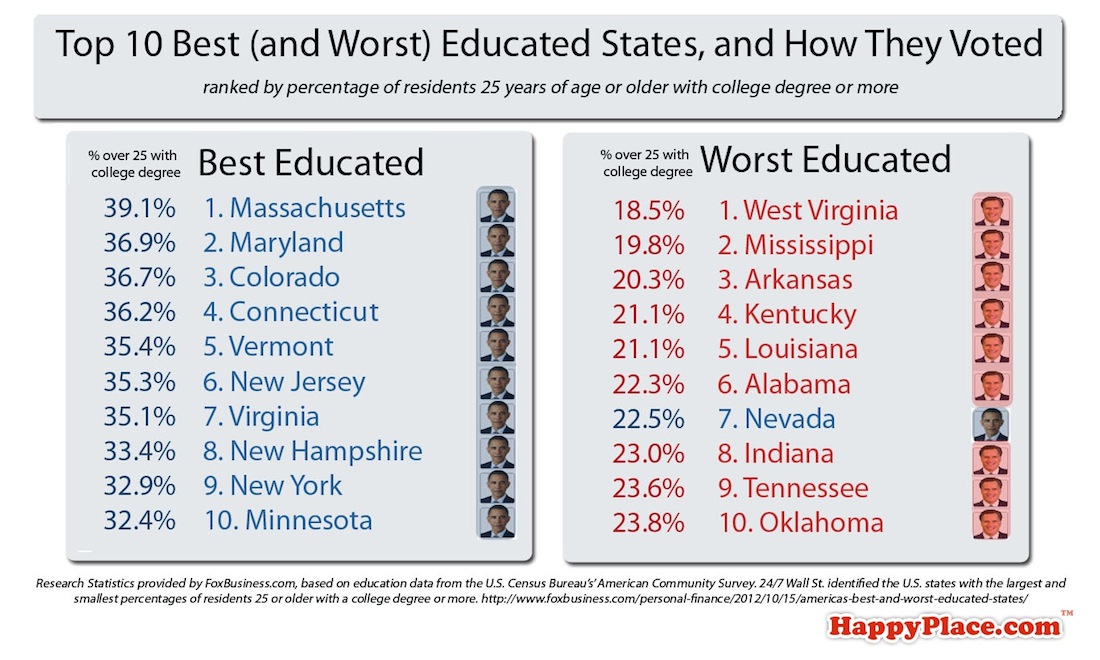
Well, something else that I found particularly interesting about this election was the demographics of the voters. Take a look at this graphic:
Some interesting things happened this year. First of all, several states legalized gay marriage. Also, Washington and Colorado legalized recreational use of marijuana. And finally, Puerto Rico voted to begin the process of becoming the 51st state. Crazy stuff, right?
Well, something else that I found particularly interesting about this election was the demographics of the voters. Take a look at this graphic:
I'm not trying to make any political statements here. I just found it very interesting that so many of the best-educated states voted Democrat. This may say something for the enriching experience that college provides and for the open, more liberal mindset that we often gain at college.
Graphic Responses
For this week's reading blog, I'll be taking a look at the article written by W.J. Broz.
Broz talks about the value of having students do a graphic response supported by a rationale rather than simply writing a tradition paper.
He writes, "The effort this deer-hunter student put into his graphic response is one of the phenomena I have continued to observe: students at all levels of ability will put great effort into graphic interpretations." It really is suprising how much more willing a student is to put effort into a visual response rather than a written response. I have no clue what it is about graphic responses that make students do this, but either way it's true. I remember spending absurd amounts of time in high school on what could have easily been quick projects. Instead, for some strange reason, I felt that it was necessary to put a ton of effort into things. I really don't know why . . . any ideas why we do this?
There's another component to the value of graphic responses. Broz writes, "With graphic responses, however, I have found that students cannot easily be 'too general.'" I never really had a big problem with being too general, but I know many, many people who do have this problem. Like Broz says, doing a graphic response can help alleviate the problem. It's hard to make a quality paper by being general, but it's even harder to make a quality graphic response by being general.
Friday, November 2, 2012
Some comments on Kist, Chapter 5
This week I just have a few things to comment on about the reading from the Kist book.
On page 98, Kist talks about how one of the teachers involved in the Facebook group logged on solely to act as a "devil's advocate." Personally, I think this is a great way to teach students how to not only form their own opinion, but to be able to defend it. It's one thing to make a statement, but to defend it against sound, opposing logic is an entirely different thing.
On page 99, Kist talks about how the students were more motivated to keep up with the Facebook group "because they own this, they love it." I guess I can say that I feel a bit of that for this blog. Though I'm not a huge fan of blogging (mostly because of a lack of time), I still feel that this is, in a way, a representation of me, and I want it to be an adequate one.
Telecommuting also came up in the chapter. I have a lot of mixed feelings about this. In college, I would love to have this sort of set up. It would save me a 15 minute drive and a gallon or two of gas while allowing me to more or less create my own schedule. I'd love for that to happen at the college level.
However, I don't know if I would trust it to work at the high school level. I just have trouble thinking that high schoolers would have the dedication to keep on task. I know that personally, if I were given the option to telecommute in high school, I would have jumped on it solely because I wanted to sleep in more. Being a pretty lazy student in high school, I doubt that I would have kept on track. Now that I'm at the college level and I care much more about school, I don't think it would be a problem. Kist reports that the program has been a success though, so I'm just not entirely sure what to think at this point.
On page 98, Kist talks about how one of the teachers involved in the Facebook group logged on solely to act as a "devil's advocate." Personally, I think this is a great way to teach students how to not only form their own opinion, but to be able to defend it. It's one thing to make a statement, but to defend it against sound, opposing logic is an entirely different thing.
On page 99, Kist talks about how the students were more motivated to keep up with the Facebook group "because they own this, they love it." I guess I can say that I feel a bit of that for this blog. Though I'm not a huge fan of blogging (mostly because of a lack of time), I still feel that this is, in a way, a representation of me, and I want it to be an adequate one.
Telecommuting also came up in the chapter. I have a lot of mixed feelings about this. In college, I would love to have this sort of set up. It would save me a 15 minute drive and a gallon or two of gas while allowing me to more or less create my own schedule. I'd love for that to happen at the college level.
However, I don't know if I would trust it to work at the high school level. I just have trouble thinking that high schoolers would have the dedication to keep on task. I know that personally, if I were given the option to telecommute in high school, I would have jumped on it solely because I wanted to sleep in more. Being a pretty lazy student in high school, I doubt that I would have kept on track. Now that I'm at the college level and I care much more about school, I don't think it would be a problem. Kist reports that the program has been a success though, so I'm just not entirely sure what to think at this point.
Transcendentalists and why we should all be reading Emerson RIGHT NOW
As some of you may know, Permenter's American Lit I course is currently studying transcendentalism. "What's transcendentalism?" you might ask. Well, that's a very difficult question that I should be writing a 1000 word essay about (you'd think by this point, I'd have gotten better with procrastination).
Anyhow, the movement was fathered by Ralph Waldo Emerson. He and his contemporaries--Thoreau, Fuller, Alcott, etc.--believed in experiencing the world for oneself and giving meaning to things through one's own perspective. They heavily supported individualism, but at the same time realized that we are all connected to each other, that each of our actions has an effect on others.
That's much less than even a sparknotes version of it all. I HIGHLY recommend reading Emerson's works, especially "Self-Reliance." Also, check up on some Thoreau while you're at it. (For an extremely epic experience, read "Self-Reliance" aloud while playing some Explosions in the Sky.)
Quotes for you to enjoy:
"Don't be too timid and squeamish about your actions. All life is an experiment. The more experiments you make the better.”
Anyhow, the movement was fathered by Ralph Waldo Emerson. He and his contemporaries--Thoreau, Fuller, Alcott, etc.--believed in experiencing the world for oneself and giving meaning to things through one's own perspective. They heavily supported individualism, but at the same time realized that we are all connected to each other, that each of our actions has an effect on others.
That's much less than even a sparknotes version of it all. I HIGHLY recommend reading Emerson's works, especially "Self-Reliance." Also, check up on some Thoreau while you're at it. (For an extremely epic experience, read "Self-Reliance" aloud while playing some Explosions in the Sky.)
Quotes for you to enjoy:
"Don't be too timid and squeamish about your actions. All life is an experiment. The more experiments you make the better.”
"Is it so bad, then, to be misunderstood? Pythagoras was misunderstood, and Socrates, and Jesus, and Luther, and Copernicus, and Galileo, and Newton, and every pure and wise spirit that ever took flesh. To be great is to be misunderstood.”
"The only person you are destined to become is the person you decide to be.”
"Guard well your spare moments. They are like uncut diamonds. Discard them and their value will never be known. Improve them and they will become the brightest gems in a useful life.”
"The only person you are destined to become is the person you decide to be.”
"Guard well your spare moments. They are like uncut diamonds. Discard them and their value will never be known. Improve them and they will become the brightest gems in a useful life.”
Subscribe to:
Comments (Atom)